
Reference
How to read a frame size marking.
Every frame we make carries three numbers on its temple. They are the fastest, most reliable way to specify sizing to a manufacturer — more reliable than a description, and far more reliable than a photograph.
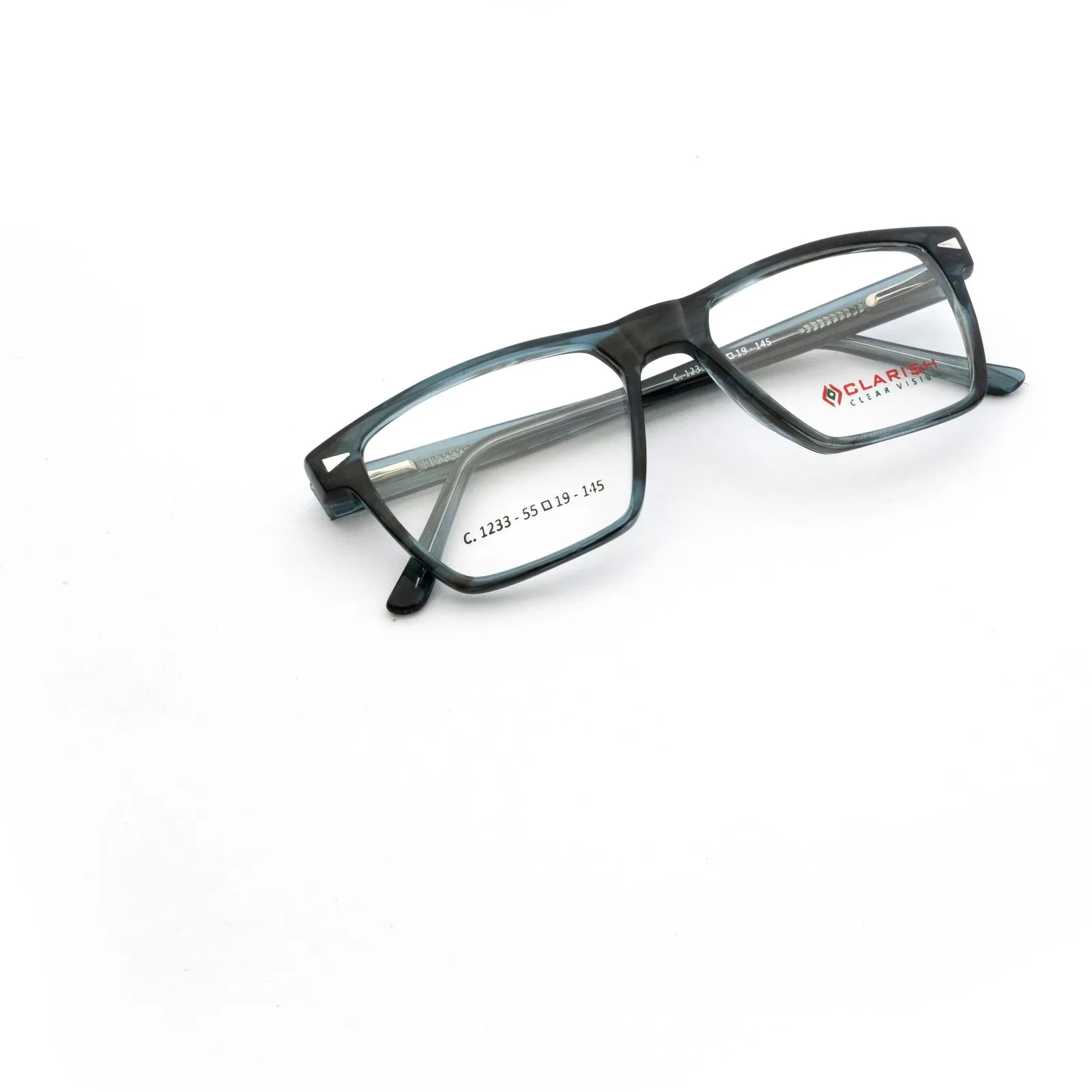
Clarish™ C-1233 — the marking as printed on the temple.
The three numbers
55 □ 19 – 145, decoded.
Read left to right: lens width, bridge width, temple length. All in millimetres. The □ symbol tells you the measurements were taken under the boxing system.
| Measurement | Example | What it controls |
|---|---|---|
| Lens width (eye size) | 55 mm | The horizontal width of one lens opening, measured at its widest point under the boxing system. It is the first number in the marking and the one that most affects how wide the frame reads on a face. |
| Bridge width (DBL) | 19 mm | The distance between the two lenses — “distance between lenses”. A wider bridge lifts the frame and suits a lower or broader nose; a narrower bridge sits closer. |
| Temple length | 145 mm | The full length of the arm from the hinge to the tip, following the bend. 140 and 145 are the common lengths in adult ranges. |
The fastest way to specify sizing
Take a frame that already sells well in your market, read the marking off its temple, and send us those three numbers. It removes more ambiguity than any written description, and it is the first thing we ask for on a sizing enquiry.
Current range
Sizes across the Clarish™ collection.
The models we are running now, with the marking read from each photographed frame. Sizing can be adapted for your market.
| Model | Shape | Lens | Bridge | Temple | Marking |
|---|---|---|---|---|---|
| Clarish™ C-1233 | Rectangle | 55 | 19 | 145 | 55 □ 19 – 145 |
| Clarish™ C-1264 | Panto Round | 50 | 20 | 140 | 50 □ 20 – 140 |
| Clarish™ C-1269 | Soft Square | 51 | 18 | 140 | 51 □ 18 – 140 |
| Clarish™ C-1270 | Cat-Eye | 54 | 17 | 145 | 54 □ 17 – 145 |
| Clarish™ C-1271 | Rectangle | 56 | 17 | 145 | 56 □ 17 – 145 |
| Clarish™ C-247 | Rectangle | 55 | 18 | 145 | 55 □ 18 – 145 |
Glossary
The vocabulary, plainly.
Standard industry terms, so you can read our product pages and a competing supplier's quotation with the same words.
Measurement
- Boxing system
- The standard method for measuring frames, in which each lens is treated as sitting inside the smallest rectangle that contains it. The □ symbol in a size marking indicates measurements taken this way.
- Size marking
- The lens width, bridge width and temple length printed on the temple, e.g. “55 □ 19 – 145”. Reading it off a frame you already sell is the fastest way to specify sizing to a manufacturer.
- Frame width
- The total width of the front across both end pieces. Not usually printed on the temple, but often the measurement a retailer cares about when fitting.
Frame anatomy
- Front
- The part of the frame that holds the lenses — rims, bridge and end pieces as one component.
- Temple
- The arm running from the hinge over the ear. Cut from the same sheet as the front on a matched acetate frame.
- End piece
- The outer corner of the front where the hinge is seated. A common failure point if there is too little material around the hinge.
- Keyhole bridge
- A bridge shaped like an old keyhole, resting on the sides of the nose rather than across it. Common on panto and round shapes.
- Lens groove
- The channel cut into the inside of the rim that the glazed lens seats into. Cut to the shape the glazing lab will work to.
Material & construction
- Cellulose acetate
- A plant-derived thermoplastic made by treating purified cellulose with acetic acid and acetic anhydride. Supplied as sheet, coloured through its full section, and heat-adjustable once finished.
- Laminated sheet
- Acetate sheet built from two or more coloured layers pressed together. As the rim is milled, the layers surface at different depths and produce visible depth in the finished frame.
- Graduated sheet
- Sheet in which the colour transitions from saturated to clear within the material itself, so the gradient survives polishing rather than being polished away.
- Core wire
- A metal insert set into each temple so the arm holds an adjustment instead of drifting back. Visible through the acetate on transparent models.
- Barrelling / tumbling
- Polishing frames in a rotating barrel with polishing media over successive stages. The main source of gloss on a finished acetate frame — and the stage most often cut short.
- Injection moulding
- Forming frames by injecting molten plastic into a mould. Cheaper and lighter than cut acetate, but colour is usually a surface treatment rather than through the material.
Sourcing
- OEM
- Original equipment manufacturing — the buyer supplies the design and the manufacturer produces to it under the buyer’s brand.
- ODM
- Original design manufacturing — development starts from the manufacturer’s existing shapes and is adapted to the buyer’s requirements.
- Private label
- The buyer applies their own branding and packaging to models the manufacturer already produces.
- ISO 12870
- The international standard for spectacle frames, setting requirements and test methods for construction, dimensional tolerances and stability, resistance to perspiration, bridge deformation, lens retention and endurance.
- HS 9003 / 9004
- Customs classifications. 9003 covers frames and mountings for spectacles and their parts; 9004 covers complete spectacles and goggles, with 9004.10 for sunglasses.
- MOQ
- Minimum order quantity. Usually set per model and per colourway rather than as a single figure across a whole collection.

Let's work together
Send us the marking off a frame you already sell.
Three numbers off a temple tell us more than a page of description. Send them with your quantities and destination market and we will come back with what we can produce.